|


|
| The
4CS |
Diamonds
and other gemstones are weighed in metric carats: one carat
is equal to 0.2 grams, about the same weight
as a paperclip. (Don’t confuse carat with karat,
as in “18K gold,” which refers to gold purity.)
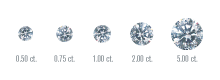 Just
as a dollar is divided into 100 pennies, a carat is divided
into 100 points. For example, a 50- point
diamond weighs 0.50 carats. But two diamonds of equal weight
can have very different values depending on the other members
of the Four C’s: clarity, color and cut. The majority of
diamonds used in fine jewelry weigh one carat or less. Just
as a dollar is divided into 100 pennies, a carat is divided
into 100 points. For example, a 50- point
diamond weighs 0.50 carats. But two diamonds of equal weight
can have very different values depending on the other members
of the Four C’s: clarity, color and cut. The majority of
diamonds used in fine jewelry weigh one carat or less.
Because even a fraction of a carat
can make a considerable difference in cost, precision is
crucial. In the diamond industry, weight is often measured
to the hundred thousandths of a carat, and rounded to a
hundredth of a carat. Diamond weights greater
than one carat are expressed in carats and decimals. (For
instance, a 1.08 ct. stone would be described as “one point
oh eight carats,” or “one oh eight.”)
How did the carat system
start?
The carat, the standard unit of weight
for diamonds and other gemstones, takes its name from the
carob seed. Because these small seeds had a fairly uniform
weight, early gem traders used them as counterweights in
their balance scales. The modern metric carat, equal to
0.2 grams, was adopted by the United States in 1913 and
other countries soon after. Today, a carat weighs exactly
the same in every corner of the world.
Diamond color
is all about what you can’t see. Diamonds are valued by
how closely they approach colorlessness – the less color,
the higher their value. (The exception to this is fancy-color
diamonds, such as pinks and blues, which lie outside this
color range.)
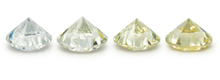 Most
diamonds found in jewelry stores run from colorless to near-colorless,
with slight hints of yellow or brown. Most
diamonds found in jewelry stores run from colorless to near-colorless,
with slight hints of yellow or brown.
GIA’s color-grading scale for diamonds
is the industry standard. The scale begins with the letter
D, representing colorless, and continues with increasing
presence of color to the letter Z, or near-colorless. Each
letter grade has a clearly defined range of color appearance.
Diamonds are color-graded by comparing them to stones of
known color under controlled lighting and precise viewing
conditions.
Many of these color distinctions
are so subtle as to be invisible to the untrained eye. But
these slight differences make a very big difference in diamond
quality and price.
Why does the GIA color grading
system start at D?
Before GIA developed the D-Z Color
Grading Scale, a variety of other systems were loosely applied.
These included letters of the alphabet (A, B and C, with
multiple A’s for the best stones), Arabic (0, 1, 2, 3) and
Roman (I, II, III) numerals, and descriptions such as “gem
blue” or “blue white.” The result of all these grading systems
was inconsistency and inaccuracy. Because the creators of
the GIA Color Scale wanted to start fresh, without any association
with earlier systems, they chose to start with the letter
D—a letter grade normally not associated with top quality.
Because diamonds
formed deep within the earth, under extreme heat and pressure,
they often contain unique birthmarks, either internal (inclusions)
or external (blemishes).
Diamond clarity refers to the absence of these inclusions
and blemishes. Diamonds without these birthmarks are rare,
and rarity affects a diamond’s value. Using the GIA International
Diamond Grading System™, diamonds are assigned a clarity
grade that ranges from flawless (FL) to diamonds with obvious
inclusions (I3).
Every diamond is unique. None is absolutely perfect under
10× magnification, though some come close. Known as Flawless
diamonds, these are exceptionally rare. Most jewelers have
never even seen one.
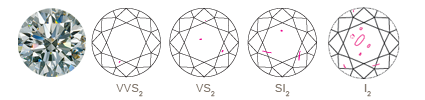
The GIA Clarity Scale contains 11
grades, with most diamonds falling into the VS (very slightly
included) or SI (slightly included) categories. In determining
a clarity grade, the GIA system considers the size, nature,
position, color or relief, and quantity of clarity characteristics
visible under 10× magnification.
Flawless (FL) - No inclusions or
blemishes are visible to a skilled grader using 10× magnification
Internally Flawless (IF) - No inclusions and only blemishes
are visible to a skilled grader using 10× magnification
Very, Very Slightly Included (VVS1 and VVS2) - Inclusions
are difficult for a skilled grader to see under 10× magnification
Very Slightly Included (VS1 and VS2) - Inclusions are clearly
visible under 10× magnification but can be characterized
as minor
Slightly Included (SI1 and SI2) - Inclusions are noticeable
to a skilled grader using 10× magnification
Included (I1, I2, and I3) - Inclusions are obvious under
10× magnification and may affect transparency and brilliance
How did the GIA Clarity
Scale come about?
Like the color scale, GIA’s clarity
grading system developed because jewelers were using terms
that were easily misinterpreted, such as "loupe clean,"
or "piqué." Today, even if you buy a diamond in another
part of the world, the jeweler will likely use terms such
as VVS1 or SI2, even if her language is French or Japanese
instead of English.
Cut is the
factor that fuels a diamond’s fire, sparkle and brilliance.
The traditional 58 facets in a
round brilliant diamond, each precisely cut and defined,
are as small as two millimeters in diameter. But without
this precision, a diamond wouldn’t be nearly as beautiful.
The allure of a particular diamond depends more on cut
than anything else.
Though extremely difficult to analyze
or quantify, the cut of any diamond has three attributes:
brilliance (the total light reflected from a diamond),
fire (the dispersion of light into the colors of the spectrum),
and scintillation (the flashes of light, or sparkle, when
a diamond is moved).
An understanding of diamond cut
begins with the shape of a diamond. The standard round
brilliant is the shape used in most diamond jewelry. All
others are known as fancy shapes. Traditional fancy shapes
include the marquise, pear, oval and emerald cuts. Hearts,
cushions, triangles and a variety of others are also gaining
popularity in diamond jewelry.
As a value factor, though, cut
refers to a diamond’s proportions, symmetry and polish.
For example, look at a side view of the standard round
brilliant. The major components, from top to bottom, are
the crown, girdle and pavilion. A round brilliant cut
diamond has 57 or 58 facets, the 58th being a tiny flat
facet at the bottom of the pavilion that’s known as the
culet. The large, flat facet on the top is the table.
The proportions of a diamond refer to the relationships
between table size, crown angle and pavilion depth. A
wide range of proportion combinations are possible, and
these ultimately affect the stone’s interaction with light.
In early 2005, GIA unveiled a diamond
cut grading system for standard round brilliants in the
D-to-Z color range. This system, the product of more than
15 years of intensive research and testing, assigns an
overall diamond cut grade ranging from Excellent to Poor.
How does pavilion depth
affect a diamond's cut?
The distance from the bottom of
the girdle to the culet is the pavilion depth. A pavilion
depth that’s too shallow or too deep will allow light
to escape through the sides or the bottom of the stone.
A well-cut diamond will direct more light through the
crown.
|
|